Asphalt Shingles vs. Metal Roofing in Ottawa: A 30-Year Cost Comparison
For a 2,000-square-foot roof, asphalt shingles cost roughly $9,000 to $15,000, while metal roofing costs about $18,000 to $32,000. That makes asphalt the easy winner on upfront price.
Over 30 years, the answer is less tidy, but asphalt still usually has the financial edge. Metal becomes competitive when the asphalt roof needs an early replacement, the metal quote is near the bottom of its range, or the homeowner plans to keep the property well beyond 30 years.
That is the short answer. The useful answer depends on what the quotes include, when future work happens and which type of metal roof is being proposed. For how we install it, see our metal roofing service in Ottawa.
What roofing costs in Ottawa
We charge $4.50 to $7.50 per square foot for architectural asphalt shingles and $9 to $16 per square foot for metal roofing. For common roof sizes, that works out to:
| Measured roof area | Asphalt shingles | Metal roofing |
|---|---|---|
| 1,500 sq. ft. | $6,750–$11,250 | $13,500–$24,000 |
| 2,000 sq. ft. | $9,000–$15,000 | $18,000–$32,000 |
| 2,500 sq. ft. | $11,250–$18,750 | $22,500–$40,000 |
Confirm whether a proposal includes HST, removal and disposal, underlayment, flashing, ventilation work, snow retention and repairs to damaged decking.
The relevant measurement is the roof’s surface area, not the home’s floor area. Pitch, overhangs, garages, porches and dormers can make a roof considerably larger than the building footprint.
A more useful 30-year comparison
Consider a 2,000-square-foot roof. The table below uses today’s price ranges in constant 2026 dollars and assumes a future asphalt replacement costs the same amount after inflation. It excludes HST, financing, repairs, maintenance and project-specific extras.
The present-value column discounts future spending at 2% a year after inflation. In plain terms, a bill paid 20 or 25 years from now does not carry the same economic weight as a bill paid today.
| Scenario | Cash paid by year 30, in 2026 dollars | Present value at 2% | Position at year 30 |
|---|---|---|---|
| Asphalt lasts the full 30 years | $9,000–$15,000 | $9,000–$15,000 | Roof is near the end of its assumed life |
| Asphalt replaced in year 25 | $18,000–$30,000 | $14,500–$24,100 | Replacement roof is 5 years old |
| Asphalt replaced in year 20 | $18,000–$30,000 | $15,100–$25,100 | Replacement roof is 10 years old |
| Metal installed today | $18,000–$32,000 | $18,000–$32,000 | Roof may have 10–20+ years left |
Two points matter here.
First, counting the full price of a second asphalt roof makes sense when looking at cash outlay, but it can distort a strict 30-year comparison. If that roof is installed in year 25, the homeowner has used only five years of it by year 30. The remaining life is not guaranteed resale value, but it is not worthless either.
Second, delaying a major expense has financial value. At a 2% real discount rate, a payment made in year 25 is worth about 61% of the same payment made today. At 4%, it is worth about 38%. Actual borrowing costs, future roofing-price inflation and the homeowner’s own investment alternatives will change the result.
Here is how much the actual quotes matter. Suppose asphalt is quoted at $13,000 and metal at $24,000. If the asphalt roof is replaced in year 25 at the same inflation-adjusted price, the two asphalt installations have a present cost of about $20,900, still below metal. Change the quotes to $14,000 for asphalt and $20,000 for metal, and the same calculation comes to about $22,500 for asphalt. In that case, metal is already ahead. There is no universal break-even price.
The practical conclusion is that asphalt normally costs less over a 30-year window. The ranges begin to overlap if shingles fail early and metal is priced aggressively. A 40- or 50-year analysis would make metal look better because more of its potential life falls inside the comparison period.
Lifespan is a range, not a countdown
We expect about 25 to 30 years for architectural asphalt shingles and 40 to 50 years or more for metal. Neither range is a promise.
Service life depends on climate, roof design, material quality, installation and maintenance. Flashing errors, poor attic air sealing, blocked ventilation, storm damage and complicated valleys can shorten the life of either system.
Material still matters, but the label alone does not tell you how long a roof will last. A carefully installed shingle roof can outlast a poorly detailed metal one. Replacement decisions should be based on the roof’s condition, not only its age or warranty term.
“Metal roofing” is not one product
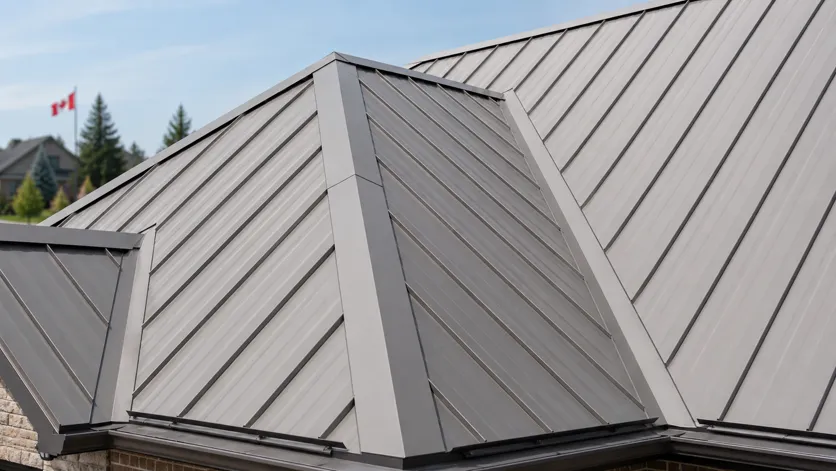
A metal quote should say exactly what is being installed. Residential systems include standing seam, metal shingles and exposed-fastener panels, in steel or aluminum. They differ in seams, fasteners, coatings, maintenance needs and price.
Ask the contractor to identify:
- the panel system, material and thickness
- whether fasteners are concealed or exposed
- the coating and finish warranty
- the underlayment and fastening method
- how valleys, walls, chimneys, vents and skylights will be flashed
- whether the existing roof will be removed or covered
- how damaged decking will be found and priced
- the snow-retention design, if one is needed
- the workmanship warranty and transfer rules
Claims of 60-year metal roofs usually trace back to research on one low-slope, unpainted, aluminum-zinc-coated steel standing-seam system. That does not prove every residential metal roof will last 60 years.
Ottawa snow and ice change the specification
The roof covering itself does not prevent ice dams. They commonly begin when heat escaping into the attic warms the roof deck and melts the snow above it. The water refreezes when it reaches the colder eaves.
Air sealing and insulation are the main controls. Proper ventilation helps, but ventilation alone will not correct uncontrolled heat leakage. Before either type of roof is installed, the contractor should look for blocked soffits, uneven insulation, condensation and previous ice-dam damage.
Sloped metal roofs introduce another issue: snow and ice may release suddenly instead of shedding gradually. Snow retention should be designed for the roof geometry and expected loads. Placing a short row of guards only above a doorway can concentrate forces rather than safely manage the full snowpack.
A long warranty is not a lifespan guarantee
“Lifetime” usually describes the duration of coverage under defined conditions. It does not mean the product will last for the life of the house.
Read the exclusions before comparing warranty lengths. Check when coverage becomes prorated, whether labour and disposal are included, which ventilation and installation rules apply, and whether the warranty can be transferred. The manufacturer’s material warranty and the contractor’s workmanship warranty are separate.
Compare scope before price
A $22,000 metal proposal that includes deck repairs, new flashing and snow retention is not directly comparable with a $15,000 shingle proposal that excludes them.
Get at least three written quotes based on the same scope. Each should state the measured roof area, product line, removal method, underlayment, eave protection, flashing, ventilation, deck-repair price, disposal, HST treatment, payment schedule and warranty terms. If a contractor has left something out, add it to the comparison before deciding.
The City of Ottawa lists installing asphalt shingles among projects that do not require a building permit. A conversion involving structural changes or extensive deck work may be different, so confirm the requirements when the scope goes beyond replacing the covering.
Which roof makes more sense?
| Asphalt is usually the better fit when… | Metal deserves a closer look when… |
|---|---|
| Keeping the initial cost down matters most | The owner expects to keep the house for several decades |
| The owner may sell within 10–20 years | Avoiding another tear-off is worth paying for |
| One installation is likely to cover most of the ownership period | The proposed system is clearly specified |
| The metal premium would need expensive financing | The metal quote is close to the long-term cost of asphalt |
| The shingle quote has strong installation details and workmanship coverage | Flashing and snow retention have been properly designed |
Bottom line
Over 30 years, asphalt shingles are usually the less expensive choice. They cost about half as much upfront, and a possible replacement is deferred for years.
Metal can still be a sensible purchase. Its value lies in the possibility of avoiding a future replacement, not in a guaranteed 30-year saving. That case is strongest for a long-term owner comparing a competitive quote for a well-defined system.
Do not decide from broad lifespan claims or price-per-square-foot ranges alone. Compare itemized quotes with the same scope, then judge the premium against how long you realistically expect to own the house.