Flat Roof Repair in Ottawa: Common Problems, Repairs and Costs
Most flat roof leaks start at a seam, a flashing detail, a penetration or a blocked drain, and in many cases a targeted repair fixes them without replacing the roof. Flat roofs are common across Ottawa, particularly on commercial buildings, garages, additions, apartment buildings, and some newer homes. RoofRoof installs and repairs flat roofing in Ottawa, including EPDM, TPO and modified bitumen.
Despite the name, a flat roof is not normally completely flat. Most low-slope roofs are built with enough pitch to move water toward a drain, scupper, gutter, or another drainage point. When that drainage stops working properly, or when the roofing membrane and flashing begin to fail, problems can develop quickly.
A small leak does not necessarily mean the entire roof needs to be replaced. In many cases, the problem is limited to one seam, flashing detail, penetration, or damaged section of membrane. The important part is finding the actual source and determining whether moisture has reached the insulation or roof deck.
Ottawa’s weather makes that assessment particularly important. Snow, ice, spring melt, heavy rain, and repeated freeze-thaw cycles can all expose weaknesses in an aging low-slope roof.
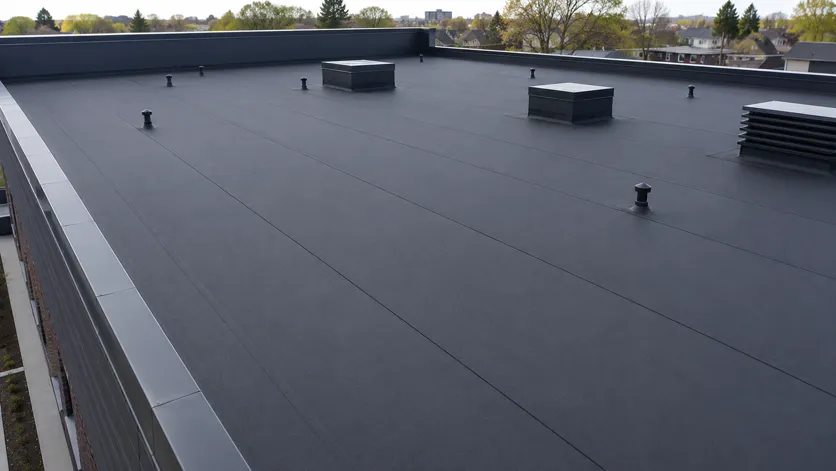
Common Flat Roof Problems
The problems seen on low-slope roofs vary depending on the age and construction of the roof, but a few come up regularly.
Leaks
Water can enter through:
- Membrane seams
- Flashing
- Roof penetrations
- Drain assemblies
- Scuppers
- Parapet and roof-edge details
- Areas that have been repaired in the past
Finding the source is not always straightforward. Water can travel through the roof assembly before appearing inside the building, so a ceiling stain does not necessarily line up with the point where water entered.
Ponding Water
Some water remaining on a roof shortly after a storm is not unusual. The concern is water that repeatedly collects in the same area and remains there well after the surrounding roof has drained.
Recurring ponding can be caused by a blocked drain, an inadequate drainage layout, a low spot, compressed insulation, or structural deflection.
If the same area holds water after every significant rainfall, it is worth investigating rather than simply repairing the membrane over and over.
Membrane Damage
Flat roof membranes can develop:
- Cracks
- Punctures
- Tears
- Blisters
- Open seams
- Failed flashing connections
- Deteriorated coatings
- Damage around penetrations
A visible defect is not necessarily the whole problem. If water has been getting underneath the membrane for some time, the insulation or decking may also need attention.
Winter Damage
Ottawa’s winters are hard on roofing systems.
Snow and ice can interfere with drainage, add weight to the roof, and make existing weaknesses more difficult to identify. Freeze-thaw cycles can also aggravate cracks, failed seams, and other areas where water has already found a way into the roof assembly.
Spring is often when these problems become obvious.
How Flat Roofs Drain
A low-slope roof relies on planned drainage. Depending on the building, water may be directed toward:
- Internal drains
- Scuppers
- Gutters and downspouts
- Other designed drainage outlets
The roof surface and drainage system need to work together. A membrane repair will not solve a drainage problem.
For example, if a low area repeatedly collects water because the roof has deflected, putting another patch over the membrane may stop one leak temporarily without addressing why the area keeps getting wet.
Ottawa’s property standards address roof drainage and recurrent ponding, as well as the requirement for roofs to remain watertight. They also address dangerous accumulations of snow and ice.
That makes recurring ponding more than a cosmetic issue, particularly when it is accompanied by leaks or visible deterioration.
Finding the Source of a Flat Roof Leak
One of the most common mistakes with a flat roof leak is assuming the damaged area is directly above the interior stain.
It may not be.
Water can move sideways through insulation, along seams, around penetrations, or through other parts of the roof assembly before it reaches the interior.
A proper investigation should therefore look at both sides of the problem.
What to Look For Inside
Depending on the building, signs of a roof problem can include:
- Brown or yellow ceiling stains
- Damp drywall
- Peeling paint
- Musty areas
- Repeated dripping during rain
- Moisture around light fixtures
- Damaged insulation
- Areas that have been repaired several times
Other sources should also be considered. Plumbing leaks, HVAC condensation, and other building-system problems can produce symptoms that look like a roof leak.
What to Look For on the Roof
The exterior inspection should include:
- Membrane seams
- Flashings
- Roof penetrations
- Drains and scuppers
- Parapet edges
- Roof edges
- Previous patches
- Blisters
- Punctures
- Tears
- Low areas
- Signs of standing water
The objective is not simply to find something damaged. It is to determine whether that damage explains the water entering the building.
Ponding Water on a Flat Roof
Ponding water gets a lot of attention with flat roofs, but not every puddle means the roof has failed.
Rain can temporarily remain on a low-slope roof, particularly after a heavy storm. The more useful question is whether the roof consistently fails to drain.
Look for patterns.
If water disappears as the roof dries, there may not be a significant drainage problem.
If the same area is still holding water long after rainfall has stopped, or if the area has gradually become deeper over time, the cause deserves investigation.
Possible causes include:
- Blocked drains
- Inadequate drainage
- Roof deflection
- Compressed insulation
- Low areas in the roof
- Changes made during previous roofing work
- Problems with the original roof design
A common rule of thumb is that a flat roof should be dry within 48 hours after rain in good drying weather. Treat it as a guide, not a rule that every roof in every weather condition must meet.
The roof’s design, weather, drainage system, and roofing manufacturer’s requirements all matter.
The practical concern is recurring ponding, not a puddle that happens to remain for a short period after a major storm.
Flat Roof Membrane Damage
The repair method needs to match the existing roofing system.
Common systems include modified bitumen, EPDM, and TPO. They have different materials, seams, flashing details, and repair requirements.
Modified Bitumen
Modified bitumen systems are commonly found on low-slope roofs and can be installed in multiple layers.
Problems may include:
- Cracking
- Blistering
- Failed seams
- Deteriorated flashing
- Surface damage
A localized defect may be repairable if the surrounding roof remains in good condition.
EPDM
EPDM is a synthetic rubber membrane that is widely used on low-slope roofs.
Potential problems include:
- Punctures
- Tears
- Failed seams
- Flashing failures
- Damage around penetrations
- Movement or deterioration of details
Repairs need to use materials and techniques compatible with the particular EPDM system.
TPO
TPO is a thermoplastic single-ply membrane.
Common problems include:
- Seam failures
- Punctures
- Flashing problems
- Damage around penetrations
- Attachment issues
Again, the repair needs to be compatible with the installed system rather than simply using a generic roofing patch.
Ottawa Weather and Flat Roof Maintenance
Ottawa’s climate is one reason regular inspection matters.
Winter
Snow and ice can interfere with roof drainage and add significant weight to a roof.
Dangerous accumulations of snow or ice may need to be removed in accordance with applicable requirements. Roof snow removal should be handled carefully, particularly on commercial buildings or roofs that are unfamiliar to the person doing the work.
Walking around on a membrane with inappropriate equipment can cause damage of its own.
Spring
Spring is an important time to check a flat roof.
Snowmelt and spring rain can expose problems that were difficult to see during winter, including:
- Blocked drains
- Persistent ponding
- Failed flashing
- Membrane damage
- Interior leaks
- Wet insulation
A roof that starts leaking during the spring thaw may have a problem that developed months earlier.
Summer
Heat and ultraviolet exposure contribute to normal roof aging. Expansion and contraction can also put stress on seams, flashing, and other details.
Older roofs can show their age more quickly when several components have already deteriorated.
Fall
Leaves and other debris can block drains and scuppers.
Cleaning drainage points before winter is simple maintenance that can prevent a relatively minor obstruction from becoming a larger problem.
How a Flat Roof Should Be Inspected
A useful inspection is about more than walking around the roof and looking for holes.
1. Start Inside
Identify where moisture is appearing and whether the problem is new or recurring.
The location, size, and pattern of interior damage can provide useful clues.
2. Inspect the Roof
Examine the membrane, seams, flashing, penetrations, drainage points, edges, and previous repairs.
Pay particular attention to areas where different materials meet.
3. Look for the Cause
If water is ponding, determine why.
If a seam has failed, determine whether it is an isolated failure or part of a broader deterioration pattern.
If a membrane is damaged, check whether moisture has reached the material underneath.
4. Check the Roof Assembly When Needed
The membrane is only one component of the roof.
Depending on the roof construction, there may be insulation and decking underneath it. If those materials have been exposed to moisture for an extended period, repairing the surface may not be enough.
Wet insulation can lose its intended performance, while deteriorated decking can create a much more serious repair.
Flat Roof Repair Options
The repair depends on what the inspection finds.
| Problem | Possible Repair |
|---|---|
| Blocked drain | Clear the obstruction and restore drainage |
| Localized membrane damage | Repair the affected membrane with a compatible system |
| Failed seam | Repair or replace the affected seam |
| Damaged flashing | Repair or replace the flashing and surrounding membrane detail |
| Persistent ponding | Correct the underlying drainage or roof-profile problem |
| Wet insulation | Remove and replace affected material where required |
| Deteriorated decking | Repair or replace damaged decking |
| Widespread membrane deterioration | Consider a larger repair, recover system, or replacement |
There is no reason to replace an otherwise serviceable roof because of one small puncture.
The opposite is also true. Repeatedly patching an old roof with widespread deterioration can become an expensive way of postponing the inevitable.
Can Tapered Insulation Fix Ponding?
Sometimes.
Tapered insulation can be used to create additional slope toward a drain or other drainage point. It can be a useful part of a reroofing or recover project when the existing roof profile is contributing to drainage problems.
It is not a universal fix.
If the roof is experiencing structural deflection, has inadequate drainage capacity, or contains widespread deterioration, adding tapered insulation may not address the underlying problem by itself.
The roof needs to be assessed before deciding whether changing the slope is appropriate.
Repair or Replace the Flat Roof?
A single leak does not tell you how much life remains in the roof.
A repair is often reasonable when:
- The damage is localized
- The surrounding membrane is still in good condition
- The roof assembly is sound
- There is useful service life remaining
- The insulation and decking are not extensively damaged
Replacement or a larger roofing project becomes more reasonable when:
- Failures are occurring in several locations
- The membrane is extensively deteriorated
- Large sections contain wet insulation
- The roof deck is damaged
- Drainage problems are widespread
- Previous repairs are repeatedly failing
- The roof is approaching the end of its service life
The number of leaks matters, but so does the condition of everything around them.
A roof with one leak and a healthy membrane is a very different situation from a roof with one leak today and five previous patches from the last few years.
How Much Does Flat Roof Repair Cost in Ottawa?
Most seam, flashing and drain repairs on a flat roof cost $400 to $1,200 plus HST. A full flat roof replacement runs $9 to $15 per square foot installed, plus HST.
The final cost depends on the roof area, membrane, access, damage, drainage, insulation, decking, flashing, labour, disposal, and the amount of work required to reach the damaged area.
That range covers localized work such as a failed seam, lifted flashing or a leaking drain.
Larger repairs involving membrane replacement, tapered insulation, extensive flashing, wet insulation, decking, or difficult access can cost considerably more. A complete flat roof replacement can reach tens of thousands of dollars depending on the building and roof assembly.
Rather than relying on an exact online price, it is better to get an inspection and an itemized estimate.
What Affects the Price?
Several factors can change the cost substantially:
- Roof size: A larger roof requires more labour and material.
- Membrane type: Different systems require different materials and installation methods.
- Access: Difficult roof access can increase labour and equipment costs.
- Extent of damage: A small membrane repair is very different from replacing a large section.
- Insulation: Wet or damaged insulation may need to be removed.
- Roof decking: Damaged decking adds both material and labour costs.
- Flashing: Parapets, walls, curbs, drains, and penetrations can require detailed work.
- Drainage: Correcting ponding may involve considerably more work than repairing the membrane itself.
- Tear-off: Removing an existing roofing system adds labour, disposal, and material costs.
- Structural problems: Deflection or other structural issues can change the scope substantially.
For that reason, a price range found online should be used for initial budgeting rather than treated as a contractor’s quote.
Questions to Ask a Roofing Contractor
If you’re getting quotes for a flat roof repair in Ottawa, don’t compare only the bottom-line number.
Ask the contractor:
- What type of membrane is currently installed?
- Where do you believe the water is entering?
- What evidence supports that diagnosis?
- Is the damage localized?
- Is there evidence of wet insulation?
- Is the roof deck in good condition?
- What is causing any recurring ponding?
- What materials will be used for the repair?
- Are the repair materials compatible with the existing membrane?
- Is the proposed work a repair, recover, or replacement?
- What exactly is included in the estimate?
- Are removal and disposal included?
- What warranties apply?
- What is excluded from the quoted price?
- Can you provide references for similar work?
A written estimate should make it clear what the contractor is proposing to do.
If one contractor recommends a small membrane repair and another recommends replacing a large section of roof, ask both to explain why. The difference may be justified, but you should understand the reason before spending the money.
Getting Flat Roof Work Done in Ottawa
Roofing companies in Ottawa provide a range of services, from emergency leak repairs and maintenance to larger flat roof replacements.
For a property owner, the important thing is to match the contractor to the work required.
A contractor handling a small leak should be able to explain where the water is coming from and what the proposed repair involves. For a larger project, the estimate should clearly identify the roofing system, materials, preparation, removal, insulation, flashing, drainage work, warranties, and exclusions.
RoofRoof Ottawa provides flat roof repair, replacement, and maintenance services in Ottawa, including flat roofing, emergency roof repair, general roof repair, and roof replacement.
Frequently Asked Questions
How often should a flat roof be inspected?
For many buildings, checking the roof in spring and fall is a sensible maintenance practice.
Additional inspections are worthwhile after major storms, when drainage problems appear, or whenever there is evidence of water entering the building.
The appropriate schedule depends on the roof system, age, exposure, building use, and maintenance history.
How long can ponding water remain on a flat roof?
A temporary puddle after a significant rainfall does not automatically mean the roof has failed.
Recurring ponding is more concerning, particularly when the same area repeatedly holds water after the roof should have drained.
Water still standing about 48 hours after rain in good drying weather is a sign of a drainage problem, though it is a guide rather than a rule for every roof.
Can a flat roof leak be repaired without replacing the entire roof?
Yes.
If the problem is limited to a membrane puncture, seam, flashing detail, or penetration, a localized repair may be all that is needed.
Replacement becomes more likely when deterioration or moisture damage extends across a substantial part of the roof.
How long does a flat roof repair take?
A small repair may be completed in a few hours if the source is easy to access and the weather cooperates.
Larger work involving membrane replacement, insulation, decking, flashing, or drainage modifications can take considerably longer.
The contractor should be able to provide a more useful schedule after inspecting the roof.
Does Ottawa’s winter weather affect flat roofs?
Yes.
Snow and ice can interfere with drainage, add weight, and make roof problems more difficult to identify.
Freeze-thaw cycles can also worsen existing cracks and other weaknesses.
Which flat roof membrane suits Ottawa?
No single membrane suits every building.
Modified bitumen, EPDM, and TPO can all be appropriate depending on the building, roof design, existing assembly, drainage, exposure, installation requirements, maintenance expectations, and project budget.
The right choice is the system that suits the specific roof, not whichever material is most popular.
How do I choose a flat roof contractor in Ottawa?
Get multiple written estimates and compare the scope of work.
Ask each contractor what they believe is causing the problem, what materials they intend to use, whether the insulation or decking is affected, and what warranties are included.
Ontario consumer guidance recommends getting written estimates and having a clear written contract describing the work, materials, costs, warranties, payment terms, schedule, and cleanup responsibilities.
How much does flat roof repair cost in Ottawa?
Most seam, flashing and drain repairs cost $400 to $1,200 plus HST, while more substantial repairs can run into the thousands.
Large membrane repairs, insulation and decking replacement, drainage work, and complete roof replacements can cost substantially more.
The roof’s size, access, membrane type, condition, and required scope of work have a much greater effect on the final price than a generic online average.
Conclusion
Flat roof repair is usually less about finding a hole and more about figuring out why the roof failed in the first place.
A leak might be caused by a damaged membrane seam, failed flashing, a penetration, a drain, or another detail. Recurring ponding may point to a blocked drain, a low area, compressed insulation, or structural deflection.
That distinction matters because a low-priced repair does not always solve the problem.
If a roof has one isolated membrane failure and the rest of the assembly is healthy, a localized repair may be enough. If the roof has widespread deterioration, wet insulation, damaged decking, or persistent drainage problems, a larger project may make more sense.
For Ottawa property owners, a sensible approach is to:
- Find the actual source of the problem.
- Determine whether the damage is localized or widespread.
- Check the condition of the materials underneath when necessary.
- Address drainage problems instead of repeatedly covering the symptoms.
- Get more than one written estimate for significant work.
- Compare the scope, materials, warranties, and exclusions rather than price alone.
RoofRoof Ottawa provides flat roof repair and replacement services in Ottawa. For a specific roof, an inspection and written estimate are more useful than relying on a generic online price.